Metrics overview
Four figures, what each one asks, and when a reading is worth acting on.
Every metric in Recomma is counted from stored chats. None of them is modelled, estimated, or derived from search rank. If a figure says 73%, you can open the chats it was counted from and read them.
The four
Visibility
The share of chats that name you at all.
Share of voice
Your share of every brand mention, once everyone is counted.
Sentiment
How favourably a chat speaks about you, 0–100.
Position
How early in a chat you are named.
And what they are a share of
The four say how a chat treated you. None of them says whether the chat was worth being in — a brand can win a corner of its category worth very little and read as a success on all four.
They answer different questions
It is tempting to read them as four versions of the same number. They are not, and the interesting cases are where they disagree:
| Pattern | What it usually means |
|---|---|
| High visibility, low share of voice | You are named in most chats, but always alongside many others. Presence without preference. |
| High visibility, weak position | You are the afterthought — named late, after the recommendations. |
| High visibility, low sentiment | You are known for something you would rather not be. Read the chats. |
| Low visibility, high sentiment | The few chats naming you like you. A distribution problem, not a positioning one. |
When a figure is a reading
A percentage measured over a handful of chats is not a measurement. Recomma is explicit about this rather than hiding it:
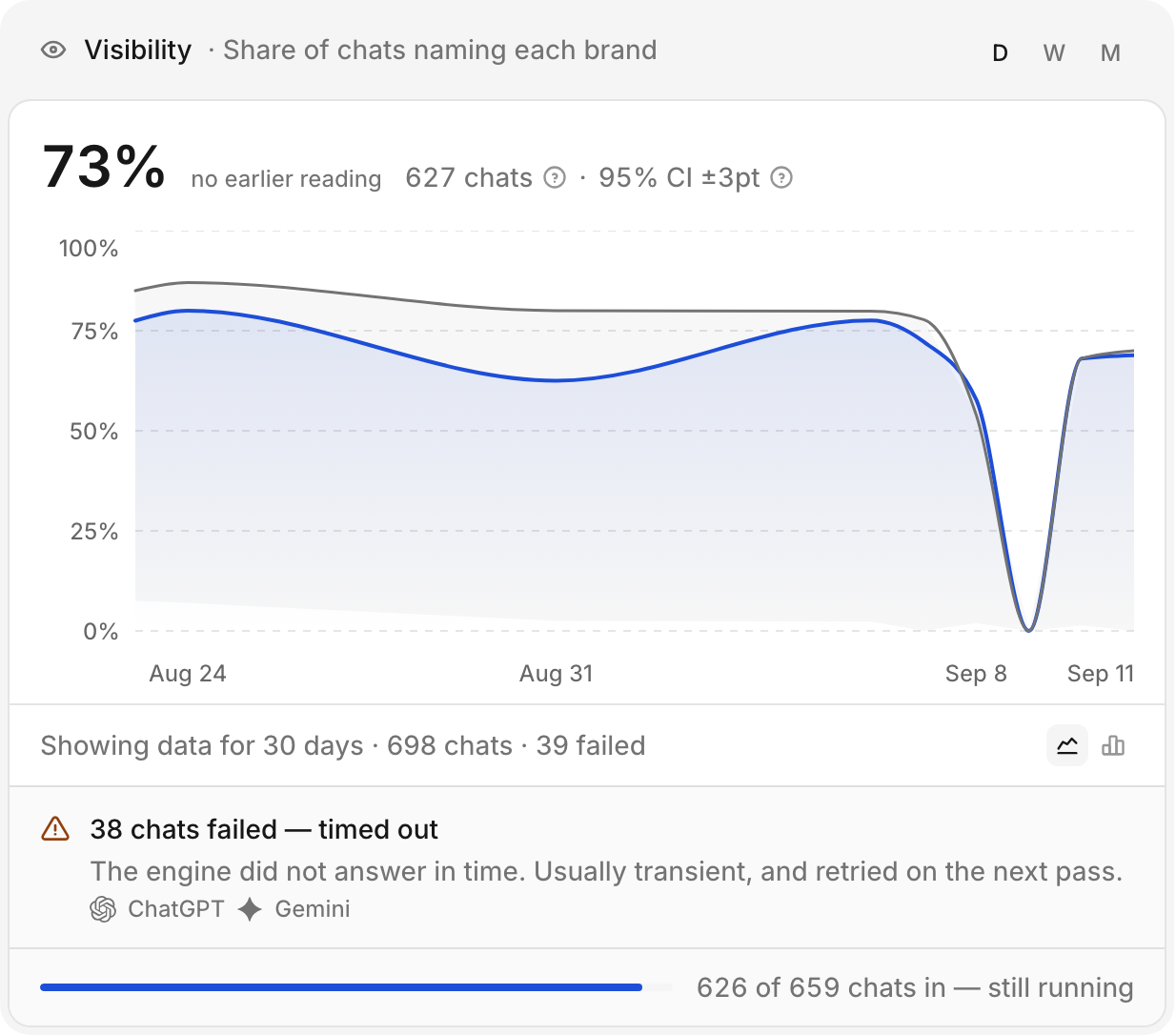
- Sample size — prompts × models × sampling days in the window. This is the number that makes a percentage mean something.
- Confidence interval — the range the true
figure is likely to sit in.
±3pton 73% means the honest claim is “between 70% and 76%”. - Below twenty chats, Recomma greys the figure out. It is not that the number is wrong; it is that one chat moves it several points, so a change between two readings tells you nothing.
- And the interval has to be narrower than the reading. Counting chats does not catch a rare event: one chat in twenty-eight clears any floor and still prints 4%, where the interval runs 0.6% to 17.7%. A figure that cannot be told apart from zero is dimmed too, however many chats are behind it.
Reading a change
Before calling a movement real, check that it is larger than the intervals on
both sides. A jump from 61% to 66% with ±5pt on each is not a jump.
Scope
Every figure obeys the filter bar at the top of the Overview, and every filter changes the denominator:

- Period — the window the chats are drawn from.
- Model — one model, or all of them. Models disagree substantially; an all-models figure is an average over that disagreement.
- Topic — one topic’s prompts, or all of them. This is the filter that turns “how visible are we?” into the more useful “how visible are we on the questions we care about winning?”