Prompts
The questions you track, and everything that follows from choosing them well.
Prompts are the whole measurement. Every figure in Recomma is counted from chats for these questions, so the set you keep decides what the numbers mean.
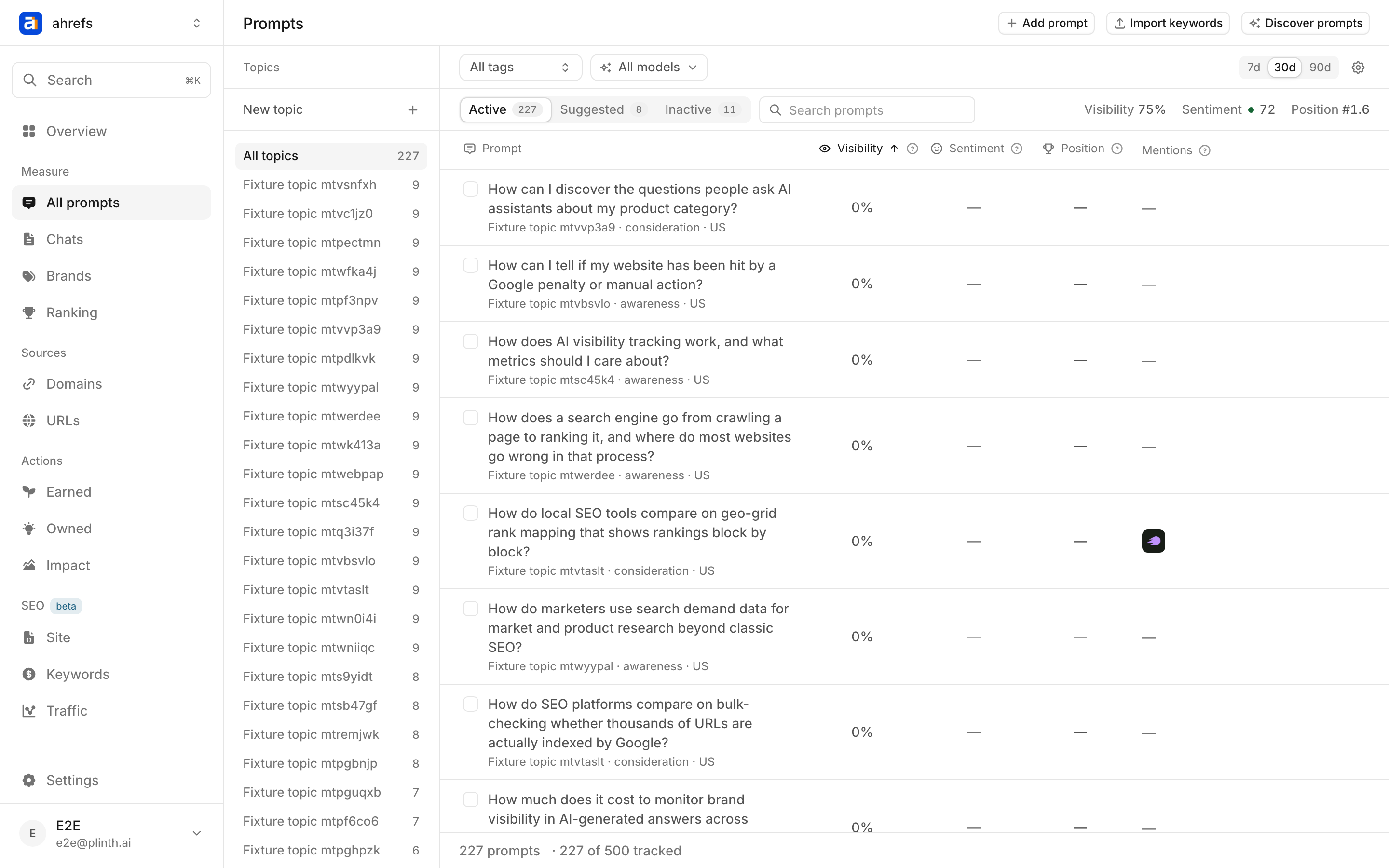
The table
One row per tracked question, each with its own reading:
| Column | What it shows |
|---|---|
| Prompt | The question, its topic, funnel stage and market |
| Visibility | The share of this question’s chats that named you |
| Sentiment | How favourably they spoke about you |
| Position | How early you were named |
| Mentions | Which brands were named, in order |
This is where an Overview figure becomes actionable. A visibility of 73% across the project is a number; the six questions at 0% are a list of things to do.
The default sort is worst-first, because the question you open this page with is “where am I losing”.
The topic rail
Topics on the left, prompts on the right. A prompt carries exactly one topic, and the rail lists whatever topics the prompts carry — there is no separate list to maintain, and a topic with no prompts under it does not exist.
Adding a topic and writing its first questions is therefore one action, not two.
Tabs
- Active — tracked and sampling.
- Suggested — proposed but not yet tracked. These cost nothing while they sit here. Tracking one starts consuming credits on the next cycle.
- Inactive — kept, not sampling. Their history is preserved.
Why suggestions wait
Coverage grows on purpose rather than by surprise. A discovered prompt sits in Suggested until a person accepts it, so nobody finds their bill has grown because the product found forty more questions worth asking.
Adding prompts
Three ways in, all landing in the same place:
- Add prompt — write one yourself.
- Import keywords — paste a list, typically from Search Console. Recomma turns them into questions; a bare keyword measures nothing, because models answer questions.
- Discover prompts — Recomma reads what you already track and proposes questions you are missing. Suggestions cost nothing until accepted.
- Suggest prompts from uncovered demand — on Keywords, the keywords your category is contested on that no tracked topic reaches. Same writer, same destination; the list comes from the market rather than from you.
Adding a topic proposes its first questions in the same step, ticked by default, with the stage each one was assigned. What you untick is never stored.
Writing a good prompt
A prompt should be a question a buyer would actually type, specific enough that a useful chat names brands:
| Weak | Better | Why |
|---|---|---|
crm software | What's the best CRM for a small B2B sales team? | A keyword is not a question |
is Acme good | How does Acme compare to Salesforce for a 20-person team? | Invites a comparison, which is what buyers ask |
best software | What's the best project management tool for agencies? | Unscoped questions produce unscoped chats |
Cover the whole decision. A set that is all awareness questions tells you about category presence and nothing about whether you win the comparison — and the comparison is where deals are lost.
Deleting a prompt
Deleting removes its history. The readings you have built are per prompt, so a prompt deleted after a month takes that month with it. Prefer Inactive if you might want the question back.