Keywords
The priced market behind your prompt set, row by row, and the demand no question measures.
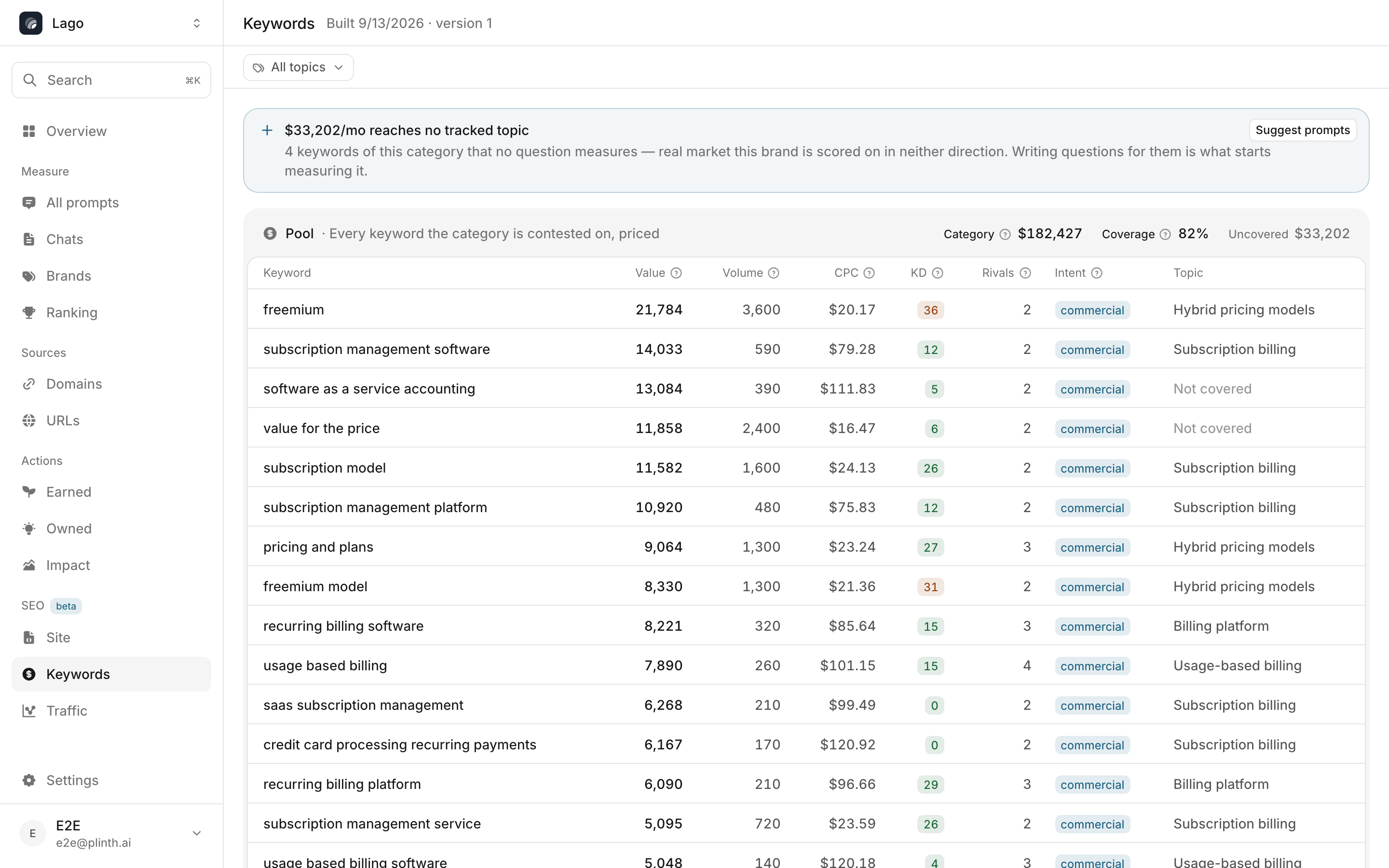
Keywords is the evidence behind the Market panel. Category value and prompt coverage are arithmetic over a table, and a customer who cannot read the table has been handed a figure to believe rather than one to check. So the table is the page, and the figures sit in a line above it saying what it adds up to.
What is in the pool
Not every keyword in your category — the ones at least two of the tracked domains rank in the top 20 for, with commercial or transactional intent, priced and cut at 95% of the total value. The full recipe is on the Market value page, including what it deliberately throws away.
The result is small on purpose. A pool of a few dozen keywords is normal; it is the contested commercial head of a category, not a keyword export.
The header carries the version and the date it was built. A pool is rebuilt monthly and kept as a numbered version, so a figure you quoted last month can still be reproduced.
The table
One row per keyword, ranked by what it is worth:
| Column | What it shows |
|---|---|
| Keyword | The query, after near-identical variants were merged into one row |
| Value | Monthly searches × 0.3 × CPC — this keyword’s share of the category value |
| Volume | Monthly searches in the project’s country, from Google |
| CPC | What advertisers bid for a click, from Google Ads. A dash means it is unpriced |
| KD | Keyword difficulty, 0–100, banded by colour |
| Rivals | How many of the tracked domains rank in the top 20 for it. Two is the floor |
| Intent | commercial to compare, transactional to buy |
| Topic | The topic it was placed on, or Not covered |
The three inputs follow Value in the order they multiply, so the arithmetic on a row can be checked across it rather than taken on faith.
Difficulty weights nothing. It is shown because it changes what the work costs — under 30 is a page, over 60 is a project — but ranking is by value alone until difficulty has been tested against a real queue.
Uncovered demand
The topic filter has a Not covered option, and above the table sits the figure it belongs to: how much monthly value reaches no tracked topic at all.
That is the one number on this page that is directly actionable. It is not a gap in your visibility — it is demand you are being scored on in neither direction, because no question asks about it.
Suggest prompts hands those keywords to the same writer that turns an imported keyword list into questions. Everything it writes lands in Suggested on Prompts, which is the state that waits for a person before it starts spending credits — so this proposes work rather than committing your budget.
If it reads the list and writes nothing, it says so. A category whose uncovered demand is four generic keywords genuinely has no question worth tracking behind them, and that is a finding rather than a failure.
Before the first pool
Pools are built on the schedule, about once a month, and a project needs at least one competitor with a domain — the pool is defined by what you and your rivals rank for, so with no rival there is nothing to contest.
Until then the page says there is no pool, rather than showing an empty table. The same applies to the Market panel on the Overview: it does not render until there is something to render.