Sources
Which sites the models trust on your subject, and what they say about you.
A chat is not an opinion the model formed on its own. It is assembled from pages the model read while answering, and those pages are recorded.
Sources is where visibility stops being a symptom and becomes something you can act on: if the pages a model trusts on your subject do not mention you, no amount of writing on your own site will change the chat.
Each of the two pages opens the same way — the scope bar, what moved, what the chats rest on, and then the table itself.
The scope bar is the Overview’s: period, model, locations and topic, each built from what has actually been sampled. Everything below it re-reads under the scope, so “which sites does Gemini trust in the UK” is the same page asked a narrower question.
Retrievals over time
The five sources the models reached for most, day by day, switchable to weeks or months. Everything else here is a stock take of how the field looks now; this is the only reading that says what changed, and a source the models started reaching for last week is the cheapest lead on the board because nobody has worked it yet.
Movers
The same rows read four ways.
| Tab | What it lists |
|---|---|
| Top | Most retrieved in the window |
| New | Retrieved in this window and never before it |
| Trending | Retrieved more than in the window before this one |
| Losing | Retrieved less than in the window before this one |
Clicking a row filters the table below to it. New, Trending and Losing are claims against earlier history, so on a workspace younger than one window they say so rather than listing everything as new.
Domain types, URL types
Beside the movers, the same window split by kind: on Domains, whose site the chats rested on; on URLs, what shape of page. The two answer different questions and the hints say which — “whose site, not what shape of page”, and the reverse — because the same chat is both a corporate domain and a comparison page, and reading one split as the other is the mistake the pair is arranged to prevent.
This is a shape-of-the-category reading rather than a scoreboard. A field resting on reference and editorial pages is won with documentation and coverage; one resting on discussion is won in communities.
Domains
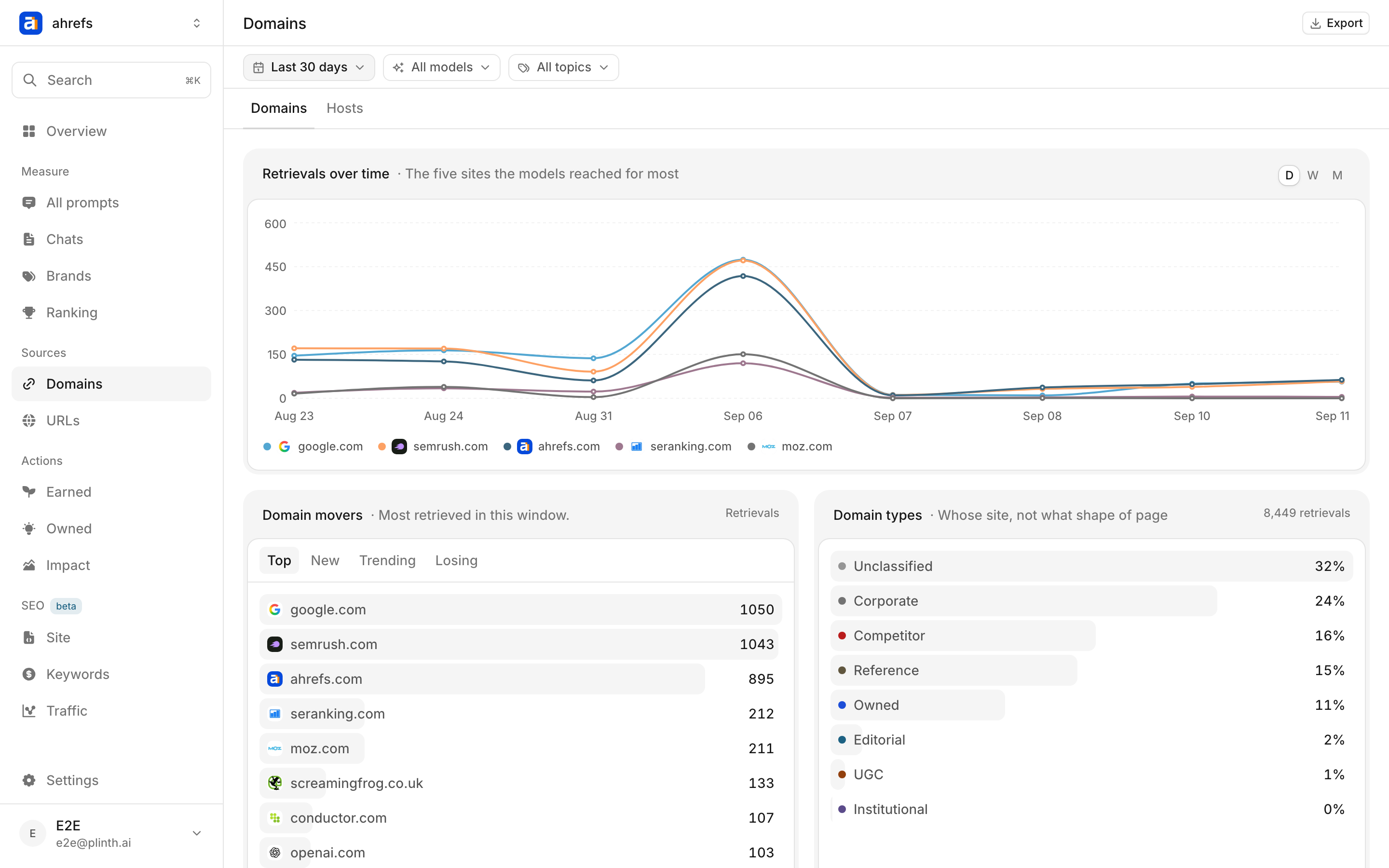
Every site the chats leaned on, ranked. The columns:
| Column | What it counts |
|---|---|
| Type | What kind of site it is, or Unclassified where nothing has placed it yet |
| Mentions | Which of your tracked brands were named in the chats that used it — you first |
| Retrievals | Every time a model reached for it, cited or not, counted in full |
| Retrieved | Share of all chats in the window that reached for it |
| Retrieval rate | Retrievals ÷ chats that retrieved it: how many of its pages a chat opens |
| Citation rate | Citations ÷ chats that retrieved it: how heavily a chat that opened it ends up quoting it |
Mentions is the column that turns this table into a to-do list. A domain retrieved in 40% of chats whose stack never shows your logo is being trusted on your subject while saying nothing about you. That is a gap, and Opportunities ranks them for you.
Domains and Hosts
stripe.com and docs.stripe.com are one site and two hosts. The Domains
tab rolls a site up from its hosts; Hosts splits them apart again.
The rollup is the one you want first — without it a company’s docs, blog and marketing site compete with each other for a row instead of adding up to one, and no row in the table answers “which sites do the models trust”. Hosts is the one you want second, because “their docs are cited and their blog is not” is a different instruction from “their site is cited”.
URLs
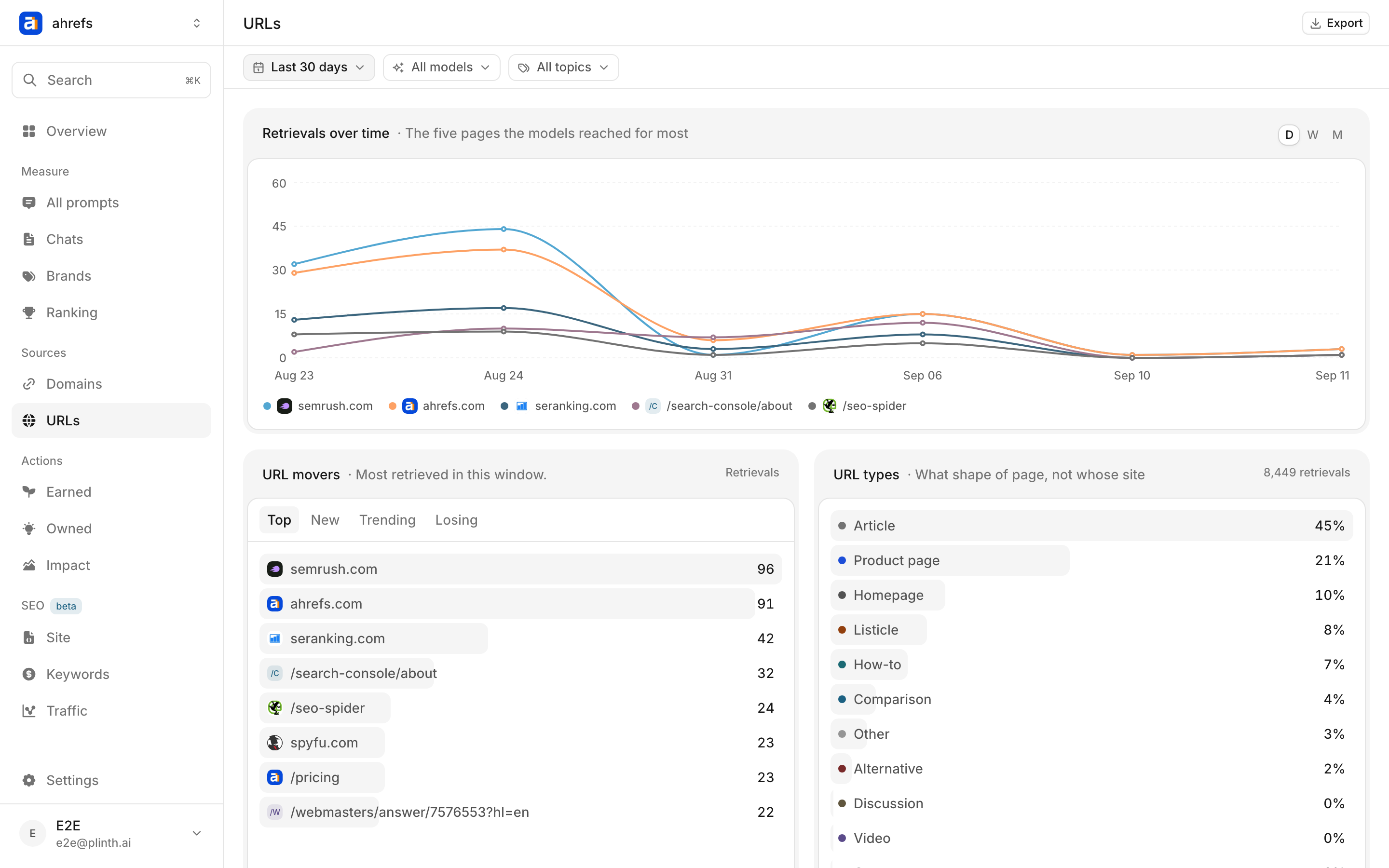
The same question one level down: not “which sites” but “which pages”. This is what you need before you can do anything — “get mentioned on TechRadar” is not a task, but “this specific comparison page is retrieved in 60 chats and does not list us” is.
Two of its columns are its own:
- URL type — what shape the page is: article, product page, comparison, alternative, listicle, how-to, homepage, discussion, video. Separate from whose site it is on, and the only one of the two that says what to go and write. “A third of what the models read about us is comparison pages” is an instruction; “a third is on corporate domains” is a fact.
- You — whether your brand was named in any chat that used this page.
The shape is worked out from the URL and, where the page has been fetched, its title. It does not need the crawler to have succeeded: Reddit blocks crawlers and is the single most-cited source on some workspaces, and a column that shows a dash for a quarter of its rows is a column nobody reads.
Names you
Both tables carry a Names you control beside the type filters. It keeps only the sources whose answers named your brand, or only those whose answers never did — and the second is the to-do list: pages the models trust on your subject that are doing their work for somebody else.
“Named” is decided across the window: one answer naming you while using the source is enough for it to count as named. The filter is applied in the query, so the pager’s total is the total of the narrowed set, not of the page on screen.
Export CSV writes that same narrowed set — every row the current scope and filters select, not only the page on screen and not the whole project.
Read but not cited
Where a model reports the pages it opened, Recomma records the ones it read and then did not cite. Retrieved and cited are separate figures throughout for exactly this reason:
- Never retrieved — the model did not find the page. A discovery problem.
- Retrieved, not cited — the model found it and did not think it worth quoting. A content problem.
The two need opposite fixes, and a table with one number for both makes them look identical.
Crawlability
Each domain carries what its robots.txt says about AI crawlers — GPTBot,
ClaudeBot and the rest. A site that blocks them has made a choice about being
quotable, and one that blocks them while ranking well in classic search is a
site whose influence in AI chats will fade.
Worth checking on your own domain first — and Site is where to do it, because that one reads the whole agent list and keeps a history of what changed, while this is one domain’s verdict beside its numbers.
Your own site is a source like any other
It appears in these tables as type Owned. If your own domain has a low retrieved figure on questions about your own category, that is the finding — the models are answering about you from other people’s pages.