Competitors
The field you are measured in: the tracked competitors that share of voice and position are counted across, and your own row among them.
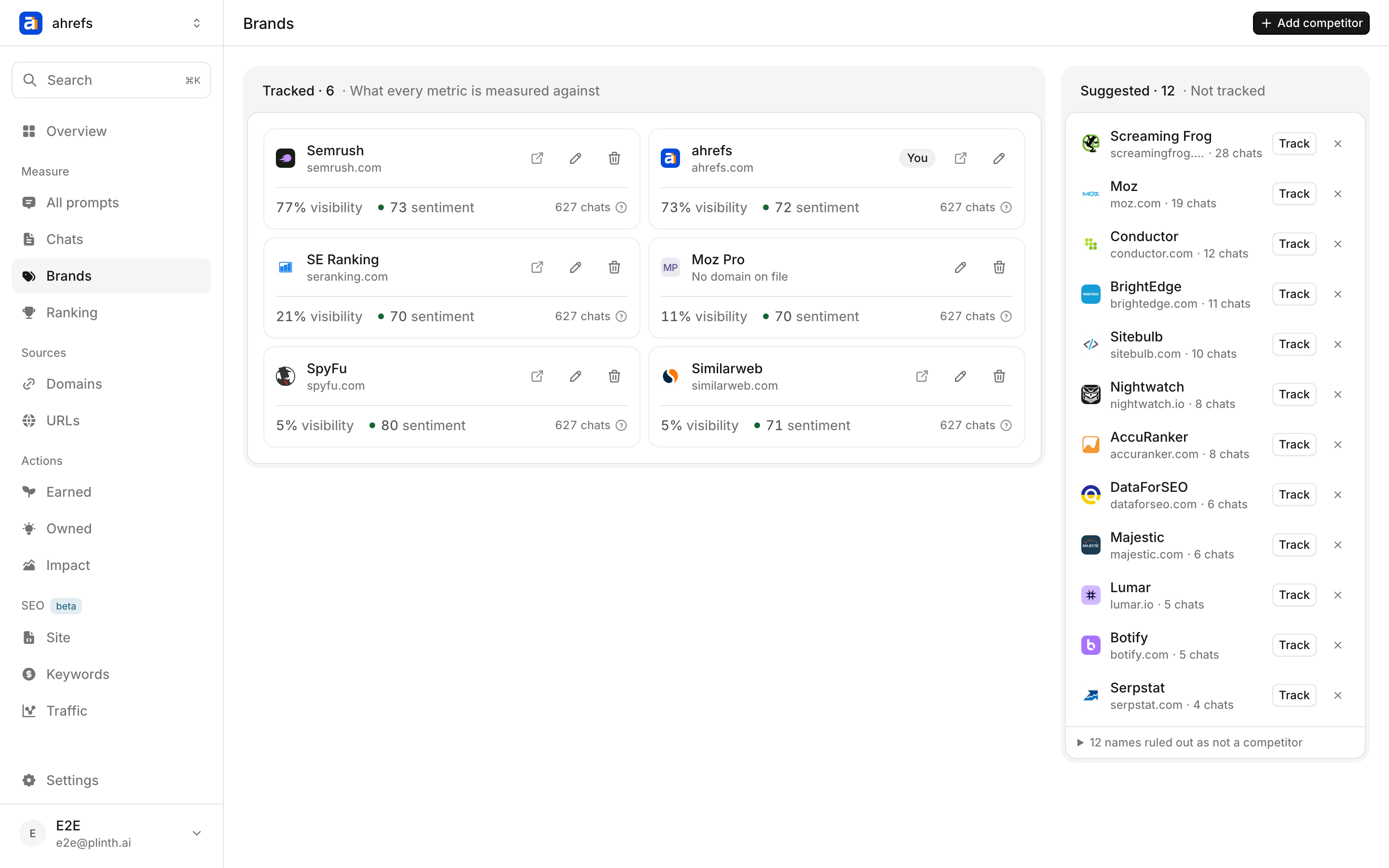
Competitors live in the project’s Settings, one panel below the brand’s own details, rather than in the rail. The list is not a report — nothing on it is read daily. It is the definition of the field that share of voice and position are computed across, changed a few times in a project’s life and consequential every time, which is what a setting is.
The old address still works: anything pointing at a project’s brands lands on this panel rather than on a dead page, because bookmarks and command-palette history outlive a move.
Why the list changes your numbers
Both metrics count across the tracked set:
- Share of voice — your mentions ÷ every tracked brand’s mentions.
- Position — where you rank among the tracked brands named in a chat.
So a rival you have not added does not dilute your share and does not push you down a position. The numbers are not wrong; they are answering a question about a field you defined.
Adding a competitor moves the baseline
Add a large, frequently-named rival and both figures will fall without anything changing in the world. Add them deliberately, and expect the step.
Suggested competitors
Recomma proposes brands it has actually seen the models naming alongside you, in your chats. This is usually a better starting list than the one a team writes from memory: the models routinely name rivals nobody internally thinks of as rivals — adjacent tools, incumbents you thought you had moved past, and occasionally a category you did not know you were being put in.
Each suggestion links out to the site it resolved to, so you can check what it actually is before accepting.
Accepting one starts counting it. Rejecting one keeps it rejected, so it is not proposed again.
Reading the table
Every tracked brand with all four metrics, your own marked. The rows worth attention are the ones where a column disagrees with the others:
- A brand with lower visibility but a better position than you is winning the chats it appears in. It is being recommended where you are being listed.
- A brand with higher visibility and lower sentiment is widely known for something. Read the chats before deciding whether you want to be there too.
- A brand climbing on share of voice while everyone’s visibility holds is taking mentions from the rest of the field.
Each row opens onto that brand’s own page — its trend, the prompts it wins, and the sources that name it. The sources one is the useful one: it is a list of pages that discuss your category and have chosen someone else.
Your own row opens your own page: where you are named, where you are not, and the sources behind each.